
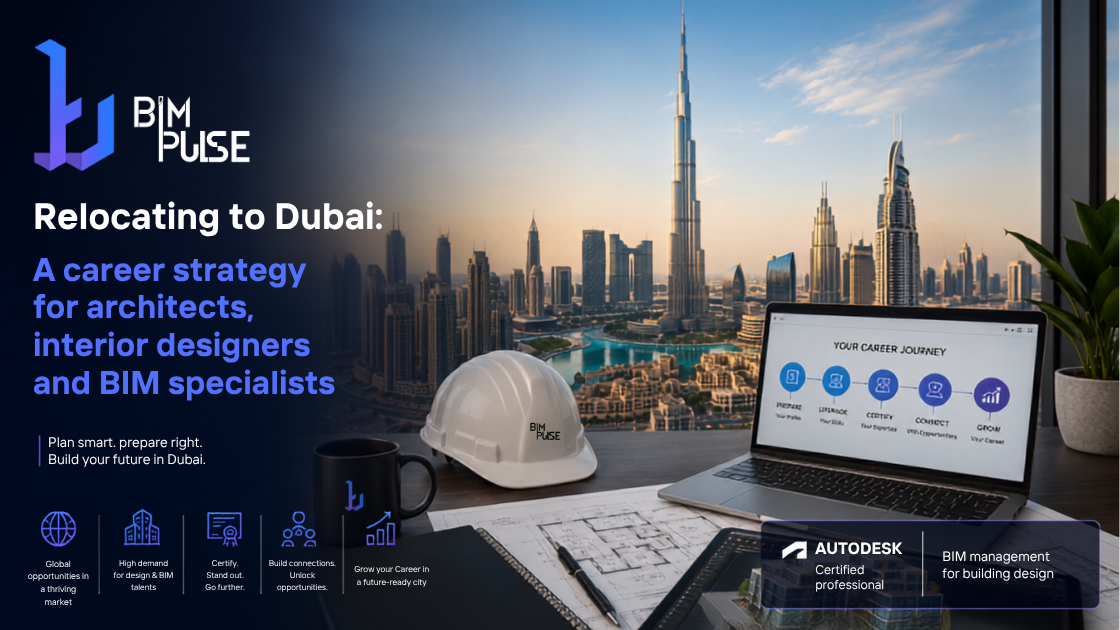
Relocating to Dubai: A Career Strategy for Architects, Interior Designers and BIM Specialists
Dubai continues to attract architects, interior designers, BIM specialists, and digital delivery professionals who want to work in one of the world’s most active built environment markets. For many professionals, relocating to Dubai is not only a geographic move. It is a career repositioning strategy that requires preparation, market awareness, portfolio clarity, BIM capability, and understanding of local project expectations.
The opportunity is real, but Dubai is also competitive. Employers and clients are not only looking for talent. They are looking for professionals who can adapt quickly, understand fast-track delivery, communicate clearly, and contribute to projects from day one.
Why Dubai Matters for Design and BIM Professionals
Dubai’s construction, real estate, hospitality, retail, infrastructure, and mixed-use development sectors continue to create demand for strong design and digital delivery capabilities. The city’s long-term urban planning vision reinforces the importance of sustainable communities, mobility, economic activity, environmental quality, and coordinated development.
For architects and interior designers, this means opportunities are not limited to concept design. The market also needs professionals who understand technical coordination, authority requirements, materiality, detailing, client presentation, and execution constraints.
For BIM specialists, the opportunity is even more strategic. Dubai’s built environment is increasingly connected to digital workflows, model-based coordination, building permit systems, data management, and project information control. BIM is no longer a secondary technical skill. It is part of how projects are coordinated, validated, documented, and handed over.
Relocation Starts Before Arrival
A successful move to Dubai should begin before applying randomly to jobs. Professionals need to prepare their positioning.
The first step is to define your target role. An architect applying as a concept designer, technical architect, design coordinator, BIM coordinator, BIM modeler, or BIM manager must present a different profile. The same applies to interior designers moving toward hospitality design, residential interiors, retail fit-out, FF&E coordination, site supervision, or design management.
A generic CV is rarely enough. Dubai employers review profiles quickly. Your experience must be clear, relevant, and aligned with the role you are targeting.
Your portfolio should also be adapted to the market. It should show not only beautiful images, but also your contribution, project scale, design stage, tools used, coordination role, technical involvement, and delivery outcome. For BIM professionals, screenshots alone are not sufficient. A strong BIM portfolio should demonstrate model organisation, coordination workflows, clash management, documentation quality, parameters, schedules, CDE processes, and multidiscipline-Specific understanding.
Skills That Strengthen Your Dubai Profile
Dubai rewards professionals who can combine creativity with delivery discipline. For architects and interior designers, strong candidates usually demonstrate design thinking, technical detailing, authority awareness, client communication, material knowledge, and the ability to work under compressed timelines.
For BIM specialists, employers increasingly value professionals who understand more than modelling. Strong BIM capability includes Revit proficiency, BIM standards, model health, QA/QC, coordination workflows, clash detection, naming conventions, information management, BIM Execution Plans, and structured handover.
Knowledge of ISO 19650 principles, Autodesk workflows, Navisworks, ACC, Revit standards, model coordination, and project information management can significantly strengthen a candidate’s position.
Professionals who combine BIM, design coordination, and project management thinking are particularly valuable because they can bridge the gap between design intent, technical production, and delivery control.
Certification and Professional Credibility
Certification is not a replacement for experience, but it can help professionals structure their knowledge and make their profile more credible. Autodesk certifications, BIM management training, Revit professional credentials, project management awareness, and ISO 19650 knowledge can support career mobility and demonstrate commitment to international digital delivery practices.
For professionals relocating to Dubai, certification can be especially useful when local employers are comparing candidates from different countries and backgrounds. It provides an additional signal of competence, particularly when combined with a strong portfolio and real project experience.
Understanding Local Codes, Regulations and Approval Workflows
Relocating to Dubai as an architect, interior designer, or BIM specialist requires more than design talent and software proficiency. Professionals must understand how projects move through local codes, authority requirements, technical approvals, and multidiscipline-Specific coordination workflows.
Dubai projects are shaped by specific regulatory expectations related to planning, building design, fire and life safety, accessibility, sustainability, MEP coordination, façade requirements, interior fit-out approvals, and construction documentation. While responsibilities vary depending on the role and project type, professionals who understand the approval process can communicate more effectively with consultants, clients, contractors, and authorities.
For architects and interior designers, this means being aware of local design regulations, material compliance, fire-rated assemblies, accessibility requirements, authority submission logic, and the level of detail expected in technical packages. For BIM specialists, it means understanding how models, drawings, data, and coordination outputs support compliance, design validation, clash resolution, and project approvals.
Professionals relocating to Dubai should also become familiar with the way local projects are delivered: fast-track timelines, multiple stakeholder reviews, consultant coordination, client-driven changes, and strong expectations for documentation accuracy. The ability to connect design intent with regulations, approvals, BIM workflows, and execution requirements is one of the strongest differentiators in the Dubai market.
How BIM Pulse Academy Supports Dubai-Ready Professionals
BIM Pulse Academy helps architects, interior designers, engineers, and BIM specialists prepare for competitive UAE and GCC project environments.
Our training goes beyond BIM software. We focus on how real projects are structured, managed, coordinated, and delivered: stakeholders, stages, approvals, deliverables, information flow, submittals, meetings, risks, milestones, reporting inputs, and decision-making workflows.
Through our Professional Leadership Transition Program, we help professionals understand how managers use BIM outputs, clash reports, model data, coordination information, and project documentation to make informed decisions. The objective is to build professionals who are not only technically capable, but also project-ready, coordination-ready, interview-ready, and delivery-ready.
From Relocation to Career Strategy
Relocating to Dubai should not be treated as a simple job search. It should be treated as a structured professional transition.
The strongest candidates are those who understand the market, adapt their portfolio, strengthen their technical skills, validate their knowledge, and communicate their value clearly.
For architects, interior designers, and BIM specialists, Dubai offers opportunity. But opportunity responds to preparation.
BIM Pulse helps professionals move from ambition to readiness, and from relocation to real career positioning.