
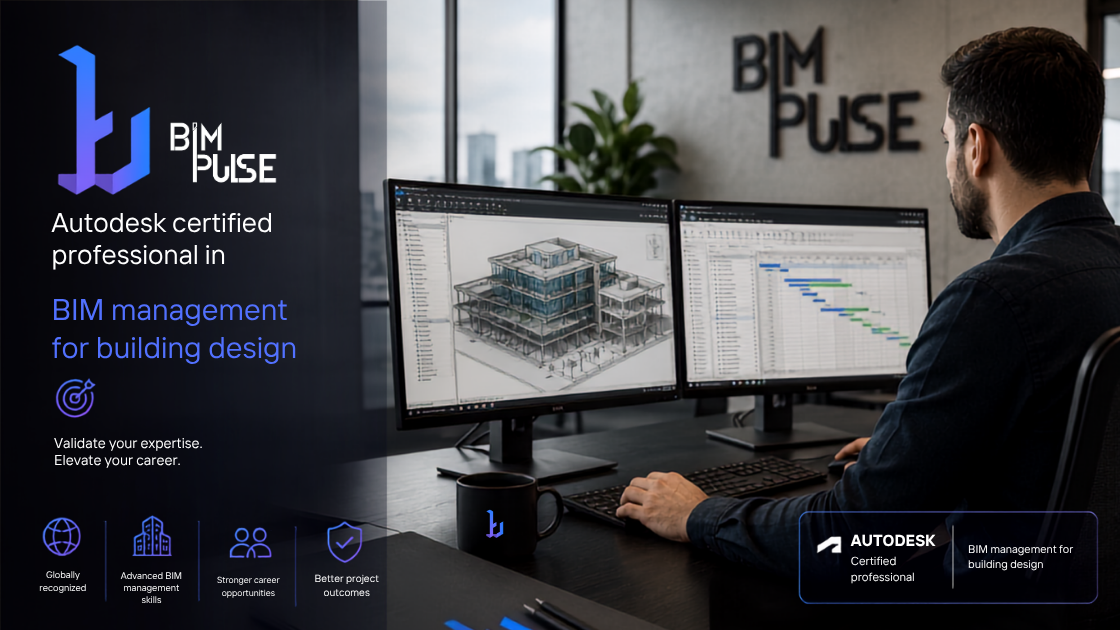
Autodesk Certified Professional in BIM Management for Building Design | BIM Pulse
For architects, engineers, BIM coordinators, and project delivery professionals, proving BIM management capability is becoming increasingly important. Many professionals need a credential that can support career mobility, strengthen client confidence, and demonstrate practical knowledge beyond software use. While no certification replaces academic education or real project experience, the Autodesk Certified Professional in BIM Management for Building Design provides a structured and internationally accessible way to validate advanced BIM management skills.
In a market where BIM is now linked to coordination, compliance, data management, quality control, and digital handover, professionals need more than modelling ability. They need to understand how BIM is planned, governed, coordinated, audited, and delivered across multidiscipline-Specific project environments.
Why This Certification Matters
BIM management is no longer limited to producing 3D models. It is a delivery discipline that connects standards, project requirements, coordination workflows, common data environments, model quality, documentation, and final handover.
The Autodesk Certified Professional in BIM Management for Building Design is designed for professionals who want to demonstrate advanced capability in managing BIM processes for building projects. It supports those working or aiming to work as BIM Managers, BIM Coordinators, Digital Delivery Managers, Architects, Architectural Technicians, Design Coordinators, and project professionals involved in BIM-based delivery.
For companies, certified professionals can help improve consistency, reduce coordination gaps, strengthen model governance, and support more reliable project information management.
From Software Skills to BIM Management Capability
One of the main strengths of this certification is that it does not focus only on tool operation. It addresses the wider management framework required for successful BIM delivery.
Key areas include BIM standards, templates, execution plans, project setup, collaboration environments, multidiscipline-Specific coordination, model health, quality control, documentation, and structured closeout.
This is important because project teams often struggle not because they lack software, but because they lack clear workflows, reliable information structures, and consistent delivery rules. A strong BIM Manager must be able to translate project requirements into a controlled digital delivery process.
What Professionals Learn to Validate
The certification preparation path focuses on the practical skills required to manage coordinated, compliant, and high-performing BIM projects. Professionals are expected to understand how to establish and maintain BIM standards, manage templates, develop BIM Execution Plans, coordinate models, manage Common Data Environments, audit model health, and support accurate project handover.
These skills are essential for project environments where multiple disciplines work together and where information must remain reliable from project setup to final delivery.
In building design projects, this can directly support better coordination between architecture, structure, MEP, interior design, client teams, consultants, and contractors.
Why It Is Valuable for the Built Environment
The architecture, engineering, construction, and real estate sectors are becoming increasingly data-driven. BIM models are now connected to schedules, cost plans, coordination reports, asset information, digital twins, and facility management requirements.
This means BIM professionals must manage not only geometry, but also information quality, naming conventions, model structure, collaboration protocols, and delivery compliance.
A recognised BIM management certification can help professionals position themselves more clearly in this evolving market. It gives employers and clients a stronger signal that the professional understands structured BIM delivery, not only design authoring.
BIM Pulse Academy Approach
At BIM Pulse Academy, we approach Autodesk Certified Professional preparation as more than exam training. Our objective is to connect certification requirements with real project delivery.
The training focuses on practical BIM management logic, including how to structure project workflows, read employer information requirements, develop BIM Execution Plans, coordinate multidiscipline-Specific models, manage CDE processes, identify model health issues, apply QA/QC procedures, and prepare digital deliverables for handover.
Our approach is designed for professionals who want to understand both the certification content and its application in real projects.
Who Should Consider This Certification?
This certification is relevant for professionals who already have BIM exposure and want to move toward BIM coordination, BIM management, digital delivery, or project information management.
It is especially useful for architects, engineers, BIM coordinators, Revit users, design coordinators, project managers, and technical professionals who want to formalise their BIM management capability and support their career development with an industry-recognised credential.
It is also valuable for companies that want to develop internal BIM standards, improve delivery consistency, and build stronger digital project teams.
From Accreditation to Real Delivery Value
The real value of certification is not the badge alone. It is the ability to apply structured BIM management principles on live projects.
A certified professional should be able to support better coordination, clearer responsibilities, stronger model quality, improved documentation, and more controlled handover. These outcomes directly affect project efficiency, client trust, and digital maturity.
For BIM Pulse, certification is not the end goal. It is a milestone in building stronger professionals, better workflows, and more reliable project delivery.
Autodesk Certified Professional in BIM Management for Building Design helps professionals validate their skills. BIM Pulse Academy helps them turn that validation into practical delivery capability.